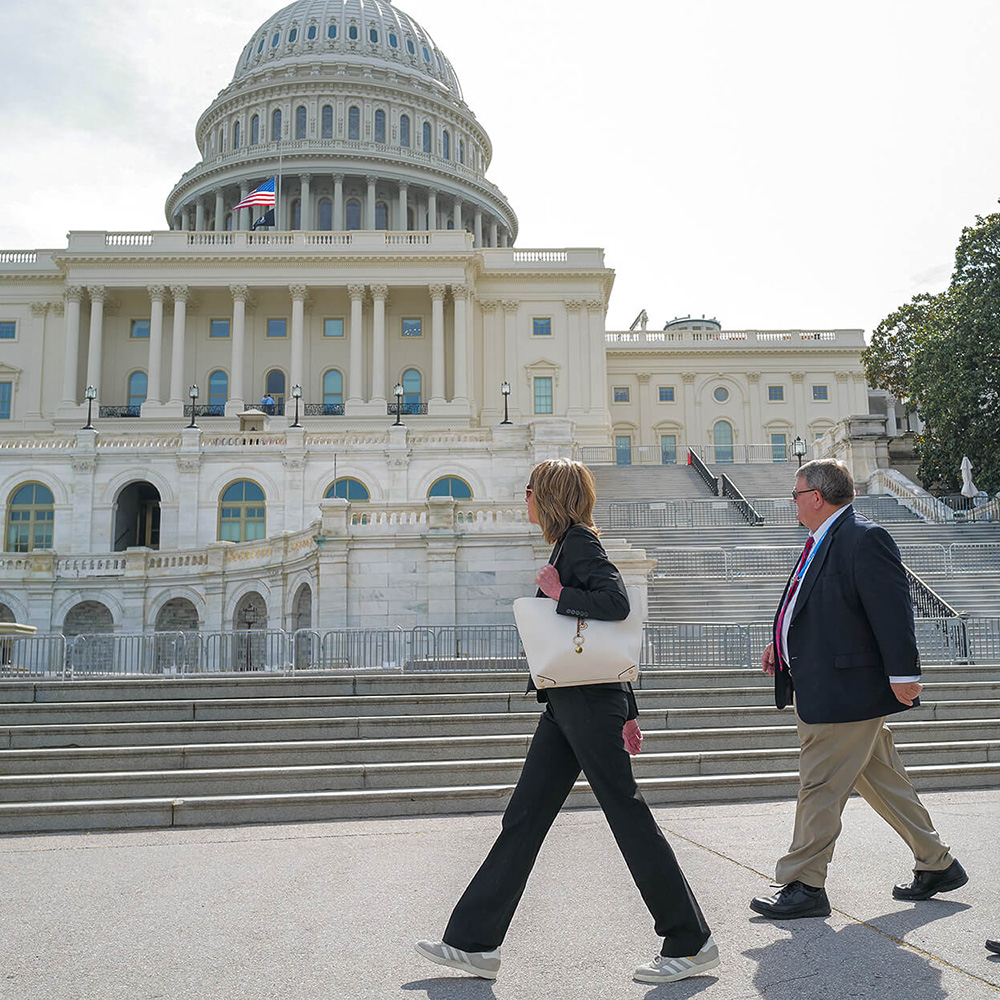
We advocate for community banks like yours. Join the fight.

Check the Action Center Example Text Policy Resolutions Example Text

What’s Hot in Advocacy

ICBA Community Bank Briefing 2026 Q2

This forward-looking webinar empowers both current and emerging leaders with the tools and insights needed to guide their institutions into the future.

Learn More Example Text

Capital Summit

The ICBA Capital Summit empowers you to make your voice heard on Capitol Hill.

Learn More Example Text

Latest News

Fed extends deadline for commenting on Reg O proposal

10/4/26  |  ICBA NewsWatch Today


All News Example Text

ICBA Advocacy in Action

The following hot-button issues are top priorities as ICBA advocates common-sense reforms on behalf of community banks and the communities they serve.

Agency CRA Proposal Creates Community Bank Relief

Due in large part to ICBA’s lawsuit challenging the 2023 CRA rule, the FDIC and OCC jointly proposed a new CRA rule in July 2026. The proposal would change the thresholds of evaluation categories. The “small bank” threshold would be raised from $412 million to $1 billion, the “intermediate bank” threshold would cover community banks from $1 billion through $10 billion, and “large banks” would be those institutions over $10 billion in assets. If finalized as proposed, more than 1,200 community banks would receive regulatory relief through the revised category thresholds. The Federal Reserve did not join in the proposal but has indicated it will promulgate its own rule. Banks should still operate under the existing 1995 framework. 

Artificial Intelligence Executive Order Recognizes Community Banks

The recent Executive Order on Promoting Advanced Artificial Intelligence Innovation and Security explicitly recognizes community banks as a critical infrastructure component, along with rural hospitals and local utilities. The E.O. follows ICBA meetings with the Administration related to AI cybersecurity and community bank impact. The E.O is expected to result in equitable access for community banks to federal AI security resources and coordination.

  • ICBA led development of a Joint AI Action Plan to urge immediate Federal action to prepare for a new era of AI-enabled cybersecurity risk.
  • AI Task Force to provide practical guidance for community bankers and recently released the Community Banker AI Security Readiness Guide to assess the AI threat shift, what it means for local institutions, and how to strengthen third-party due diligence, update and test incident response plans, among other topics.

Capital Treatment of Mortgage Lending

ICBA supports the mortgage-related revisions of the proposed capital rule which would better accommodate community banks. While supporting the 25 percent cap on mortgage servicing assets (MSAs), our comment letter urges lowering the risk weight of MSAs to 100 percent for institutions under $100 billion. Additionally, ICBA supports recognition of PMI and generally supports adjusting risk weights based on LTV for portfolio loans on the condition that banks may opt out. ICBA also urges lowering the risk weight of mortgages sold through the FHLBs' Mortgage Partnership Finance program to no more than 100 percent.

CDFI Work Group

ICBA relaunched its CDFI Work Group to identify key issues and develop strategies to address CDFI-related priorities. A top priority is urging Treasury to distribute the 2025 awarded funds before the statutory deadline of September 30, 2026.

Clarity Act Defeated on Senate Floor

On September 15, the Clarity Act (H.R. 3633) failed by a critical procedural vote by 49 yes to 51 no. (60 votes were required to proceed.) All Democrats and four Republicans voted not to begin debate on the Act, dealing highly funded crypto-proponents a major set-back in their efforts to authorize payment of interest on stablecoin balances at the expense of community bank deposits. 

The failed vote is the culmination of ICBA’s year-long, intensive lobbying, grassroots, and media campaign to highlight the adverse impact of stablecoins interest or yield and ensure the bill was not enacted without a robust prohibition on such payments. The strong engagement of community bankers nationwide was critical to this effort. ICBA has not relented in its efforts as the bill could still be reconsidered before year-end.

  • ICBA’s grassroots campaign generated 14,500 letters and 4,000 in just the last month.
  • ICBA’s quantitative analysis showed that yield-bearing stablecoins could reduce community bank lending by $850 billion.

Community Bank Regulatory Relief Becomes Law

The 21st Century ROAD to Housing Act, which became law on July 10, includes provisions to allow community banks to hold custodial deposits and more reciprocal deposits without them being considered brokered deposits; an 18-month exam cycle for banks with up to $6 billion in assets; and to promote the formation of de novo community banks.

Deposit Insurance

ICBA’s Deposit Insurance Working Group created a set of principles for reform. These include promoting depositor confidence in community banks; curbing TBTF; controlling the cost of insurance for community banks; increased coverage for community banks; and expanding the FDIC’s ability to protect community banks and their customers during crisis.

Dodd-Frank Section 1033 Rule

In August 2025, the CFPB issued a proposed rule seeking recommendations for changes to the 1033 rule. While the final rule exempts community banks with assets of less than $850 million, as advocated by ICBA, it requires non-exempt banks to create and maintain an API-enabled “developer portal” which non-bank fintechs and other third parties could use to access customer data, creating a threat to consumer data security and privacy. Moreover, banks are not permitted to charge reasonable fees to third parties to offset the significant costs of compliance with this rule. ICBA sent a comment letter to the Bureau.

Executive Order on Immigration Status Avoids Bank Citizenship Verification

In May, President Trump issued an Executive Order on protecting the financial system. Notably, the E.O. does not require banks to verify the citizenship of their customers. The E.O. directs the agencies to strengthen customer due diligence, manage credit risk of loans to unauthorized immigrants, among other provisions. In meetings and correspondence, ICBA urged the White House and Treasury not to require citizenship verification, as had been reported.

Executive Order to Create Mortgage Rule Relief

President Trump issued an E.O. directing the agencies to propose mortgage regulatory relief for banks of less than $100 billion in assets. This could include ability-to-repay, QM, and HMDA, among other burdensome rules.

Farm Bill Advances

The House passed The Farm, Food, and National Security Act of 2026 (H.R. 7567) in April. The new five-year bill will allow community banks to work with their farm, ranch, and rural customers to engage in sound business planning. The Senate Agriculture Committee passed its version in September but floor action in not expected until the post-election “lame duck” session. ICBA supports enhancements to USDA’s guaranteed loan programs including higher loan limits and prompt loan approvals. However, the Farm Credit System’s (FCS) expansion into non-farm financing activities needs guardrails.

Favorable ACRE Implementation

Following the enactment of a version of ACRE as part of the One Big Beautiful Bill, ICBA met with senior Treasury officials to ensure the implementing rules qualified that greatest number of agricultural loans, consistent with the statute. Treasury has issued largely favorable interim guidance, consistent with our advocacy. ICBA is pressing for additional flexibility in the forthcoming proposed rule.

Final 1071 Rule Includes Strong Community Bank Exemptions

CFPB’s final rule exempts institutions that originate fewer than 1,000 covered small business loans per year; defines small businesses as those with gross annual revenues of $1 million or less; and exempts agricultural loans. 

These provisions align with ICBA’s advocacy. ICBA continues to press for legislation to repeal or modify Section 1071 of Dodd-Frank.

GENIUS Act Rulemaking

In addition to the Clarity Act, the crypto industry is pressing for flexibility on stablecoin payment of interest and yield in the GENIUS Act rulemaking. ICBA has submitted multiple comment letters in response to the rulemaking. These letters stress the adverse impact to credit creation of a regulatory framework that fails to address deposit flight. 

As the agencies rush to complete rulemaking ahead of the January 18, 2027 effective date of the GENIUS Act, ICBA will continue to advocate for a regulatory framework that implements a strict prohibition on issuers paying yield and recognizes the potential for stablecoin growth to harm community bank deposits and lending capacity.

House Advances Community Bank Regulatory Relief Bills

In addition to the community bank regulatory relief provisions of the 21st Century ROAD to Housing Act (see “Real Results” below), the House passed the Main Street Capital Access Act (H.R. 6955) in July by a bipartisan vote of 270 to 155, including 56 Democratic votes. 

Provisions include lowering the range for the Community Bank Leverage Ratio to between 6 and 8 percent and making it available to banks with up to $15 billion in assets, independent review of adverse exam findings, and tailoring of rules based on risk profile and business model. ICBA is pressing for consideration of the provisions of H.R. 6955 in the Senate.

ICBA Campaign Against Credit Unions

ICBA launched “The Illusionists,” a new media campaign to reveal the ugly truth about credit unions. The campaign features a website, creditunionsrevealed.com, highlighting the industry’s deceptions, exponential growth, abuse of the tax code, and consumer harm.

  • New data analysis demonstrates that credit union-community bank acquisitions harm small businesses and local communities and that community banks outperform credit unions in high-poverty areas.
  • ICBA sent a letter to Treasury Secretary Bessent urging him to require federal credit unions to file IRS Form 990.

ICBA Fraud and Scams

ICBA created a task force, composed of more than 60 community banks and state bankers’ associations, to explore solutions to prevent, detect, and mitigate fraud and scams. The task force is just one component of ICBA’s broader strategy to work with stakeholders in Congress, the agencies, law enforcement, and industry to reduce the burden of fraud and scams, including check fraud.

ICBA published a blog post summarizing its progress to date in the fight against check fraud.

Industrial Loan Companies

ICBA filed letters opposing the deposit insurance applications of Ford, GM, Stellantis, Nissan, PayPal, and Affirm. Senators John Kennedy (R-LA) and Andy Kim (D-NJ) have reintroduced the ICBA-supported “Close the Shadow Banking Loophole Act” (S. 3734) which would permanently close the ILC loophole and prevent commercial firms from blurring the line between banking and commerce.

  • ICBA released a comprehensive white paper demonstrating the dangers of creating any new ILCs.

Master Account Access and OCC Trust Charter

Crypto firms continue to seek national trust charters and Federal Reserve master account access, despite concerns that the Fed and OCC have exceeded their statutory authorities and that these pathways into the banking system pose threats to financial stability. 

ICBA objected to the OCC’s final trust chartering rule in February and has repeatedly objected to national trust charter applications from crypto firms seeking to engage substantially in non-fiduciary activities. ICBA continues to oppose the limited master account access granted to Kraken, a crypto exchange. Our letter to the Kansas City Federal Reserve details concerns about Kraken’s key role in providing bitcoin to crypto kiosk operators facing serious state allegations of fraud.

Regulation O Thresholds Update

In August, the Federal Reserve and the FDIC issued proposed rules to update Regulation O, which limits loans to bank executives, directors, and principle shareholders. The proposals would raise the thresholds for loans to executives not otherwise specifically authorized by statute from $100,000 to $400,000 and loans to insiders not subject to prior board approval from $500,000 to $2 million. ICBA has urged the agencies to modernize these outdated thresholds. Comments are due October 5.

Section 1071 Legislation

ICBA supports the “1071 Repeal to Protect Small Business Lending Act,” (H.R. 976/S. 557)) sponsored by Rep. Roger Williams and Sen. John Kennedy. Short of full statutory repeal, the law would be significantly improved by House Financial Services Chairman French Hill’s “Small LENDER Act” (H.R. 941), and Senator Katie Britt’s PROTECTED Act (S. 2352), which would reform 1071 so that fewer community banks must comply. (See also Final 1017 Rule under "Real Results.")

Stablecoin Interest and Yield Payment Authority Defeated

As described above, the failed Clarity Act vote is a major setback to the crypto industry’s efforts to enshrine authority to pay interest and yield on stablecoin balances. ICBA is continuing its campaign to highlight the harm such payments would cause community bank deposits and the vital community loans they support.

Why Community Banks Matter

ICBA powers the potential of the nation’s community banks through effective advocacy, education, and innovation so that community banks can continue to strengthen, invest, and provide opportunities for the people and families in the communities they serve.

About ICBA Example Text About Community Banks Example Text
three people conversating while pointing at a laptop

ICBA PAC

The ICBA Political Action Committee strengthens the community banking industry's reputation in Washington. Supported by thousands of community bankers, the ICBA PAC has a history of raising over $1.85 million from over 3,000 ICBA leadership bankers, bank employees, and other supporters each election cycle.

About ICBA PAC Example Text
Group of people clapping on a meeting room

Regulatory and Legislative Advocacy

ICBA engages members of Congress and federal regulators to help them understand our industry and concerns through our Legislative Priorities for Congress and continuous push for pro-community bank policies.

Policy Resolutions Example Text
Make your voice heard Example Text