


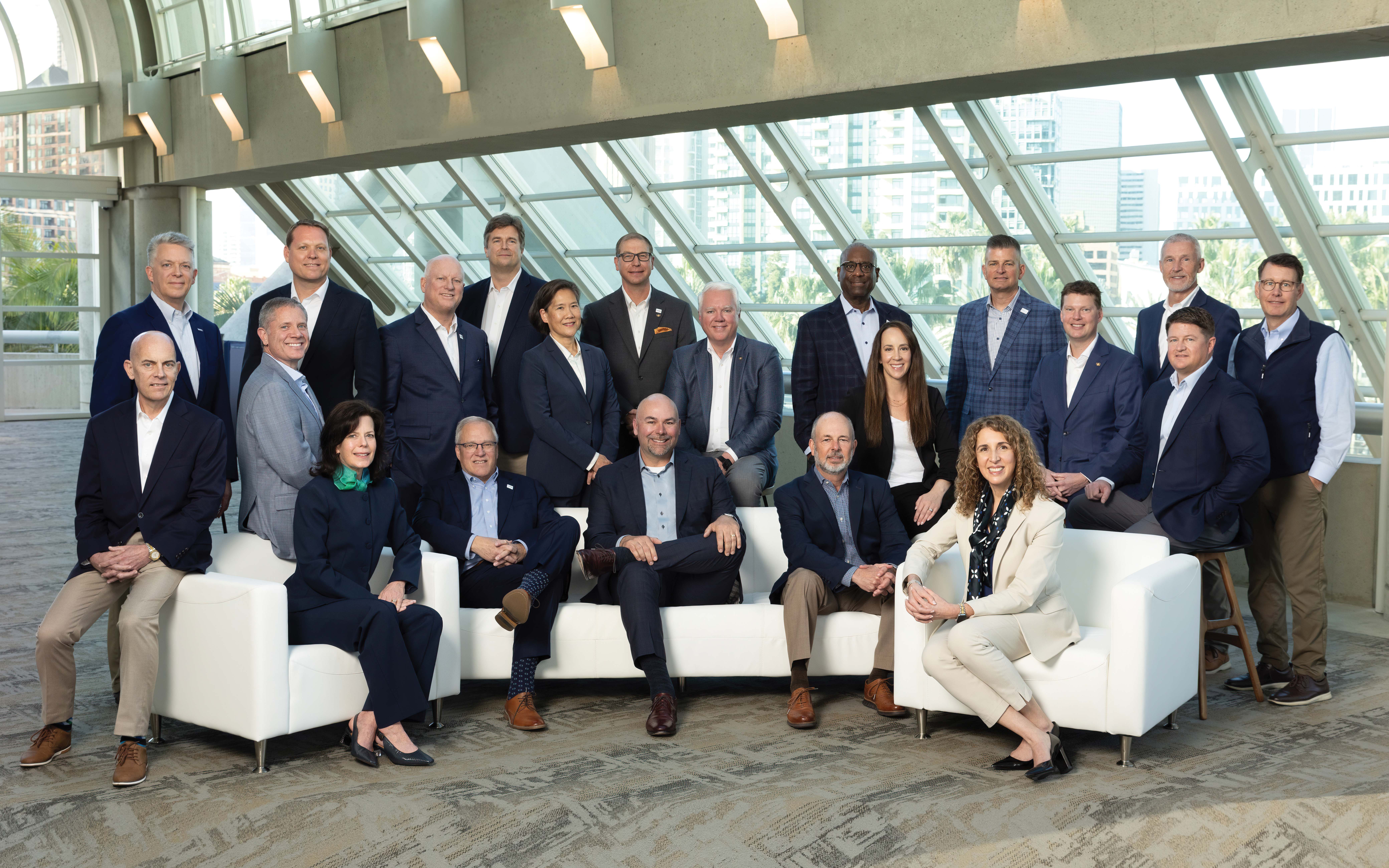
ICBA’s 2026/27 board of directors is a group of people who are not only passionate advocates for the community banking industry but also dedicated leaders of their own banks. From fostering career development to embracing technology and expanding community impact, these board members share a commitment to strengthening the industry.
“Our 2026/27 ICBA board of directors represents the very best of community banking leadership,” says Rebeca Romero Rainey, ICBA president and CEO. “Their breadth of experience, commitment to service and passion for our mission make me incredibly optimistic about what we can accomplish together as we create and promote an environment where community banks flourish.”
Here, members of the executive committee share their insights on the advocacy issues they plan to prioritize and the goals they hope to accomplish during their term.
Read on to get to know the rest of the board.
From left to right, back row:
Secretary: Douglas E. Parrott
President, CEO and chairman of State Bank of Toulon in Toulon, Illinois
Treasurer: Jill Sung
President and CEO of Abacus Federal Savings Bank in New York City
Past chairman: Derek B. Williams
President of Century Bank & Trust in Milledgeville, Georgia
Consolidated holdings chairman: Chris Doyle
President and CEO, Texas First Bank in Texas City, Texas
Past chairman: Lucas White
President of The Fountain Trust Co. in Covington, Indiana
Front row:
Chairman: Alice P. Frazier
President and CEO of Potomac Bank in Charles Town, West Virginia
Immediate past chairman: Jack E. Hopkins
President and CEO of CorTrust Bank, N.A., in Sioux Falls, South Dakota
Chairman-elect: Michael J. Burke Jr.
President of ChoiceOne Bank in Lapeer, Michigan
Vice chairman: Shon B. Myers
CEO and chairman of Farmers & Merchants Bank in Miamisburg, Ohio
ICBA president and CEO: Rebeca Romero Rainey
Washington, D.C.
Q: What are your goals for your term on the board?
Alice P. Frazier: As a member of the executive committee, we have the privilege of working closely with Rebeca Romero Rainey on strategic initiatives set by the board of directors. An initiative I believe is critical to the long-term success of our industry is succession planning for early- and mid-career bankers to lead in the future. [It] was voted a key priority by the board, and ICBA Education is uniquely positioned to help all banks with career development.
Michael J. Burke Jr.: I really want to get more community bank leaders committed to paying attention to what is happening in [Washington] D.C. in whatever way works for them. We have to speak up when we see changes on the horizon that are a threat to our industry and be vocal with our elected officials. We can’t assume they always know about the great work we do for our communities and how laws they are considering could impact how we help.
Shon B. Myers: I hope to be available to provide support to the current team and all those who have volunteered to pave the way over the past several years. We have a tremendous group of leaders that I am excited to follow and continue to learn from.
Douglas E. Parrott: My goal for my term as ICBA secretary is always to be involved to the fullest extent I can and need to be. ICBA is the only trade association that solely represents community banking, and that never leaves my heart.
Jill Sung: I have two main goals: First, to support the ICBA chair Alice Frazier, the board, Rebeca [Romero Rainey] and the amazing ICBA team, and second, to elevate my voice to advocate for community bankers across our country. To do this, I will be listening intently, particularly to those bankers who are facing more challenges due to harsher economic environments or shifting demographics, or both.
Jack E. Hopkins: [I want to] encourage more bankers to become actively involved [and] to help to promote and defend our industry from all the unregulated industries that want to be a bank without bank‑like regulation.
Lucas White: I want to continue to encourage more community bankers to get involved. The more community bankers we have telling their story in D.C., the more successful we will be.
Derek B. Williams: I want to continue to serve and represent the industry and the great community bankers of our country by helping ICBA stay strong, focused and visible as “the” voice of community banking. I also want to be sure we are providing Rebeca [Romero Rainey] and the ICBA leadership and staff with the support and encouragement they need and deserve.
Chris Doyle: [To] continue to advocate for community banks in Washington, D.C., is job number one. It is so important for Main Street America to be heard in the halls of Congress. We have a great story, but there are legislative challenges to our industry developing daily. [My other goal is to] create a community bank roadmap for onboarding future technology.
From left to right:
At-large director, Federal Delegate Board representative: John “JV” Evans III
CEO of D.L. Evans Bank in Burley, Idaho
At-large director: James H. Sills III
President and CEO of Mechanics and Farmers Bank in Durham, North Carolina
At-large director: Jason Jones
President and director of Community Financial Services Bank in Benton, Kentucky
Not pictured:
At-large director, Federal Delegate Board representative: Gay Dempsey
CEO of Bank of Lincoln County in Fayetteville, Tennessee
Q: What do you think will be the top advocacy issues during your term?
Frazier: For the first time in many years, we have a Congress and an administration that is very favorable to community banks. That has afforded progress on many fronts, but the most pressing issue today is the prevention of interest or rewards payments on stablecoins. Stablecoins are intended to be another payment solution, not an account to hold money for future transactions or increased value. Any payment of interest or rewards on stablecoins amplifies the risk of deposits permanently leaving community banks, thus affecting their ability to lend and support their local communities.
Burke: We will need to continue to advocate for fair treatment of community banks as the new stablecoin legislation becomes law. We have to protect community bank deposits, because they are the backbone for lending in our communities.
Myers: All things around digital currency and stablecoins will be front and center, as we need to ensure the current banking system is not negatively impacted. Regulatory relief also seems to have momentum that would be fantastic to push forward.
Parrott: I believe that there are two major issues that are taking a lot of our ICBA resources currently for our [grassroots] team: deposit insurance reform and the CLARITY Act. Deposit reform has many ways that it can go. It has already morphed from where it began and what was proposed to what it is now. The CLARITY Act for stablecoin legislation is a very hot topic that has passion on both sides.
Sung: Housing finance reform and distinguishing banking from crypto-assets. I believe community banks must play a vital role in these two issues to be able to continue to serve our communities in the best ways possible.
Hopkins: I think this year will be dominated by the regulation of the digital assets and cryptocurrency industry as they continue to try to become unregulated banks. We will also continue to work on deposit insurance reform.
White: Cryptocurrency and stablecoin legislation are at the top of the list this year. We must prevent stablecoin issuers from acting like banks without any of the oversight or regulations that banks have to follow.
Williams: Digital assets and stablecoin is probably the biggest [issue] for the industry overall, but deposit insurance reform also has the ability to greatly impact the community banking model. This is our opportunity to help level the playing field with the too-big-to-fail banks.
Doyle: With the level of deregulation (or no regulation) with the current administration, I am concerned about opening the floodgates to new national trust charters and industrial loan companies (ILCs). I am concerned we may wake up one day with fintechs and the like competing directly with community banks but avoiding the onerous regulation that we, as chartered banks, are held accountable to.
Why join the ICBA board of directors?
“Community banking is vital to our towns, cities, and neighborhoods. I want to use this opportunity to make sure our stories are told and our priorities are front and center.”—Jason Jones, ICBA at-large director, and president and director of Community Financial Services Bank in Benton, Kentucky
“It was an amazing opportunity to help shape the future of community banking with bankers who are as passionate as I am, and to learn from the absolute best.”—Sarah Getzlaff, ICBA policy development committee chairman, and CEO of Security First Bank of North Dakota in Bismarck, North Dakota
“I joined the ICBA board to advocate for community banks, advance key legislative efforts, push back on harmful regulations and support the organization that helps us better serve our nation’s communities.”—Andrew Silsby, ICBA bank innovations and solutions committee chairman, and president, CEO and director of Kennebec Savings Bank in Augusta, Maine
“Community banking is a treasure, and anything I can do to support the industry is an honor. I truly believe ICBA is making a positive impact for all of us, and I want to be part of that.”—Quentin Leighty, ICBA bank operations committee chairman, and president and CFO of First National Bank Colorado in Las Animas, Colorado
“I have been involved with ICBA for over 30 years. The work that ICBA does for community banks is critical to our industry.”—Robert Barnes, ICBA bank education committee chairman, and president and CEO of PriorityOne Bank in Magee, Mississippi
“ICBA does an incredible job of representing and advocating for community bankers, so it was truly an honor when I was asked to serve on the board and to have the opportunity to represent my fellow bankers and be a voice for them.”—Gay Dempsey, ICBA at-large director and federal delegate board representative, and CEO of Bank of Lincoln County in Fayetteville, Tennessee
“After serving as [a state delegate on the ICBA federal delegate board], I was pleasantly surprised to be invited to serve on the [ICBA] board and chair the [ICBA Political Action Committee]. Although I already have a full plate, I could not turn down the opportunity, knowing how hard the staff and volunteers work, and the impact that ICBA has on our industry.”—Reid B. Tingle, ICBA PAC chairman, and president and CEO of Bank of Ocean City in Ocean City, Maryland
“I joined the ICBA board because I am passionate about community banking and saw a valuable opportunity to learn from other industry leaders. I also believe it is essential to be at the table shaping policy rather than watching decisions be made without input.”—James H. Sills III, ICBA at-large director, and president and CEO of Mechanics and Farmers Bank in Durham, North Carolina
“Representing America’s community banks, ICBA is best positioned to address the key issues facing our industry. As a fifth-generation community banker, it’s important to support and maintain a strong community banking system for future generations.”—John V. Evans III, ICBA at-large director and federal delegate board representative, and CEO of D.L. Evans Bank in Boise, Idaho.
Q: If you could recommend one ICBA offering to community bankers, what would it be?
Frazier: At Potomac Bank, we are focused on career paths for our employees, thus we are actively using the Professional Development Planner to build curriculums for all non-officer positions. Our goal is to have each teammate understand the “why,” as well as the “what” they do each day. The Professional Development Planner allows us to customize each program with banking knowledge and soft skills, and to bring in classes from our core systems.
Burke: Every community banker should be using ICBA Community. This is the best way, bar none, to interact with other community bankers across the country. We are a creative bunch and there are so many great ideas that people are willing to share on the platform. It’s free advice to run our banks more efficiently.
Myers: The [ICBA] Capital Summit is an absolute must for anyone that has the opportunity to attend. We have to tell our story, and it is a fascinating process to spend a few days in Washington, D.C., if you have never done so.
Parrott: I have been a member of the [ICBA] Education Committee for six years and can attest we have the best national resource of educational seminars, webinars and informational classes that we can be most proud of.
Sung: ICBA Payments Solutions. Payments continues to grow in importance, as well as in concentration. As small banks, we need to counterbalance the power of the giant payment processors to ensure our customers are fairly charged and can access a full array of services. I’m excited and encouraged by the investment and focus ICBA has placed in this high-priority area.
Hopkins: Just one? That’s hard. But I think this year, attending the Capital Summit will be a very positive experience for the banker if they have not done it before or in a while. We have major items that we need to address with Congress this year.
White: Capital Summit, without question. Capital Summit is where members really understand what ICBA does for community banks.
Williams: As the industry and our banks grow and change, I would encourage every banker to participate in the ICBA ThinkTECH Accelerator program by taking part in the cohort companies’ presentations. Not only are you helping these technology companies learn how to best meet community banking needs; you will also almost certainly find a way to make your bank more efficient and effective at meeting your customers’ changing needs.
Doyle: Attend the ICBA Capital Summit. Advocacy is vital to the preservation of our franchise value. The [Capital] Summit provides detailed education on real community bank issues, an opportunity to network with fellow bankers across the country and, most importantly, the unique experience of meeting with our legislators and discussing issues important to our banks.
From left to right:
Bank education committee chairman: Robert Barnes
President and CEO of PriorityOne Bank in Magee, Mississippi
Rural America and agriculture committee chairman: Jim Gowen Jr.
President and CEO of Merchants & Planters Bank in Newport, Arkansas
Bank innovation & solutions committee chairman: Andrew Silsby
President, CEO, and director of Kennebec Savings Bank in Augusta, Maine
Policy development committee chairman: Sarah Getzlaff
CEO of Security First Bank of North Dakota in Bismarck, North Dakota
Bank operations committee chairman: Quentin Leighty
President and CFO of First National Bank Colorado in Las Animas, Colorado
Consolidated holdings chairman: Chris Doyle
President and CEO, Texas First Bank in Texas City, Texas
ICBA PAC chairman: Reid B. Tingle
President and CEO of Bank of Ocean City in Ocean City, Maryland
Q: Does your community bank have any notable plans for the coming year?
Frazier: As a 154-year-young community bank, [Potomac Bank enjoys] a large consumer deposit base. As you can imagine, a sizable portion of the consumer deposit base is the baby boomer or older demographic. We have an active project focused on the next generation of consumer depositors.
Burke: [ChoiceOne Bank is] leaning into learning about and implementing AI. We have an employee committee that meets regularly on AI and then reports to executive management monthly. We’ve taken the step to implement an AI solution to help our team with finding good policies and procedures within the bank. We plan to build from there on other areas of the bank that could benefit from using AI.
Myers: We [at Farmers & Merchants Bank] are seriously evaluating using three companies out of this year’s ThinkTECH [Accelerator] cohort. This will be our first time to leverage up-and-coming modern technology to be a stronger community bank.
Parrott: 2026 will be a big year for the State Bank of Toulon in the sense that we are continuing to strive and plan for proper succession, not only at the management level but the board of directors as well.
Sung: After many, many years, [Abacus Federal Savings Bank is] finally redoing our entire website. This is a huge project for us, and I’m looking forward to not only providing more convenience to our customers but also reintroducing ourselves to the public.
Hopkins: [CorTrust Bank is] going through a core conversion later in the year that will take most of our efforts. We also are in the process of building two branches: one to open in late summer and the other to open next spring.
White: We [at The Fountain Trust Co.] are in the process of acquiring another community bank. Our focus this year is ensuring a smooth integration for their customers and employees.
Williams: [Century Bank & Trust is] expanding into a couple of new markets this year that are more rural than our current market and in need of a community bank presence. We are looking forward to growing our overall footprint while reaching new customers with our commitment to service.
Doyle: There are two projects we are implementing at Texas First Bank. We are launching the Microsoft Dynamics CRM product across our entire bank and insurance agency. It has been a multiyear implementation project, but we are now ready to launch. We have [also] partnered with several local community banks in our region to hold a community fraud education event for consumer and commercial customers at our local junior college.
From left to right:
Past chairman: Brad M. Bolton
President and CEO of Community Spirit Bank in Red Bay, Alabama
Past chairman: Derek B. Williams
President and CEO of Century Bank & Trust in Milledgeville, Georgia
Past chairman: Lucas White
President of The Fountain Trust Co. in Covington, Indiana
Immediate past chairman: Jack E. Hopkins
President and CEO of CorTrust Bank, N.A., in Sioux Falls, South Dakota
Past chairman: Robert M. Fisher
Chairman, president and CEO of Tioga State Bank, N.A., in Spencer, New York
Inspiring the next generation of community bankers
Board members share advice for those just starting out in community banking.
“Build relationships with not only customers in your community but also with your fellow community bankers.”—Jim Gowen Jr., ICBA rural America and agriculture committee chairman, and president and CEO of Merchants & Planters Bank in Newport, Arkansas
“Get involved in your state community banking association and form network relationships that you can learn from throughout your career, and take up the advocacy efforts to protect our relationship model of banking, no matter what level in the bank you’re in.”—Brad M. Bolton, ICBA past chairman, and president and CEO of Community Spirit Bank in Red Bay, Alabama
“Don't be afraid to try new things. We need to continue to evolve in our industry to stay relevant.”—Robert M. Fisher, ICBA past chairman, and chairman, president and CEO of Tioga State Bank in Spencer, New York
“Community banking is made up of wonderful people, so take every opportunity you have to meet your fellow bankers and to establish relationships with them.”—Gay Dempsey, ICBA at-large director and federal delegate board representative, and CEO of Bank of Lincoln County in Fayetteville, Tennessee
“Cast a wide net and learn everything you can in your organization. Don’t isolate yourself to one area; you truly never know what you will get into on any given day. The internal relationships you build are just as important as the relationships with customers.”—Reid B. Tingle, ICBA PAC chairman, and president and CEO of Bank of Ocean City in Ocean City, Maryland
“Seek out every learning opportunity from your organization’s leaders. Do your job well, consistently deliver results, and then volunteer for additional responsibilities to grow and contribute even more.”—Andrew Silsby, ICBA bank innovations and solutions committee chairman, and president, CEO and director of Kennebec Savings Bank in Augusta, Maine
“My advice is to be a sponge and learn every aspect of how the bank operates, generates profit, leverages technology and serves customers. Community bankers wear many hats, and having a strong generalist foundation is key to long‑term success.”—James H. Sills III, ICBA at-large director, and president and CEO of Mechanics and Farmers Bank in Durham, North Carolina
“Ask questions and speak up. We can learn a lot from experienced bankers, and some of the best ideas come from people with less experience and a fresh perspective.”—Sarah Getzlaff, ICBA policy development committee chairman, and CEO of Security First Bank of North Dakota in Bismarck, North Dakota
“Get to know your bank’s financial reports and understand how you can make a positive impact on them. It is fun to contribute to your bank’s prosperity.”—Quentin Leighty, ICBA bank operations committee chairman, and president and CFO of First National Bank Colorado in Las Animas, Colorado
“Build strong relationships and be engaged in your community. Community banking is a very rewarding career where you can be involved in your community and help make a positive impact for small businesses and families.”—John V. Evans III, ICBA at-large director and federal delegate board representative, and CEO of D.L. Evans Bank in Boise, Idaho.