


In an era defined by digital acceleration, it would be easy to assume that physical branches are becoming less relevant. Mobile apps are improving. Peer-to-peer payments are mainstream. We can even pay for Girl Scout cookies with a swipe or a tap, so who needs the drive-thru ATM?
Yet our latest nationwide consumer research reveals an important and often overlooked reality: physical presence still shapes trust. Strong branch networks reinforce credibility, stability, and long-term confidence. It turns out that even in the age of smartphones and smartwatches, people still appreciate knowing there is a real building somewhere with a real sign out front.
In January 2026, the market insights experts at La Macchia Group conducted a nationwide survey of more than 1,000 consumers to better understand perceptions of the branch’s role in an increasingly digital world. The findings challenge the vocal nay-sayers who proclaim the branch is dead and reinforce a clear conclusion: a strong physical branch network continues to build trust and credibility with today’s consumers. Apparently, rumors of the branch’s demise have been somewhat exaggerated.
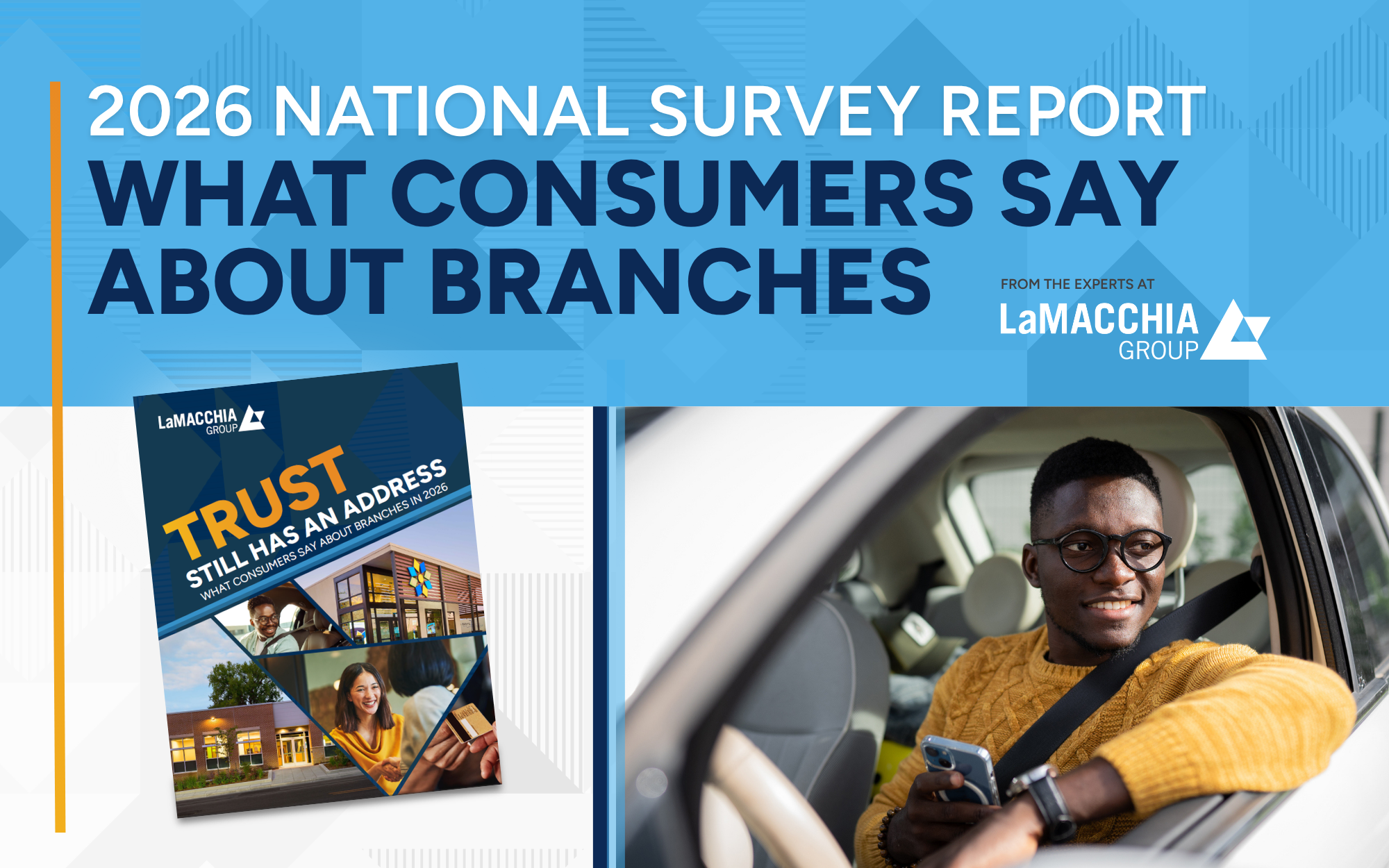
The full research is available in the whitepaper, “Trust Still Has an Address: What Consumers Say About Branches in 2026.” What follows is a snapshot of the insights shaping branch strategy today.
Across generations, consumers consistently associate physical scale with institutional strength. When asked whether a financial institution appears more established and trustworthy if it has more branch locations, a clear majority agreed. What surprised our experts is that agreement was especially strong among younger and midlife consumers, groups often assumed to be fully digital-first. Even as these cohorts lead in digital adoption, they still connect brick-and-mortar presence with legitimacy. It turns out that a physical building still sends a powerful signal.
This matters because trust remains the foundation of the primary financial relationship. While customers may experiment with fintech tools, digital wallets, and secondary accounts, most still concentrate their core banking relationship with a small number of institutions. Earning that “primary financial institution” status requires more than competitive rates or app functionality. It requires confidence that the organization will be there tomorrow, next year, and decades from now. After all, few people want their primary financial relationship to feel temporary.
When customers do visit a branch, our data shows the primary driver is simple: it’s close to home. Service quality ranks second, followed by convenient hours and proximity to work or other errands. The branch is not an afterthought. It is intentionally chosen based on accessibility and experience. In other words, convenience still wins, and a good location can beat a great app.
The data does not suggest a choice between digital and physical. Instead, it highlights an opportunity. Institutions that pair strong digital functionality with strategic physical presence are best positioned to earn trust across generations. To explore this data and more, we invite you to download the full report, “Trust Still Has an Address: What Consumers Say About Branches in 2026.”